Fire Codes and Propane Regulations
Michigan marijuana grow and processing facilities require a license to operate from the Michigan Cannabis Regulatory Agency (CRA).
- Local Fire Marshal
- Mechanical/Building Inspector
- Zoning Department
- Cannabis Regulatory Agency (CRA) / Bureau of Fire Services (BFS)
Michigan’s Propane Industry adheres to NFPA 58, and works closely with BFS.
If cannabis operations use Propane as an extraction solvent, they must follow NFPA-58 rules and regulations, enforced by BFS.
Propane is regulated by the National Fire Protection Agency (NFPA 58).
Michigan’s Propane Industry adheres to NFPA 58, and works closely with BFS.
If cannabis operations use Propane as an extraction solvent, they must follow NFPA-58 rules and regulations, enforced by BFS.
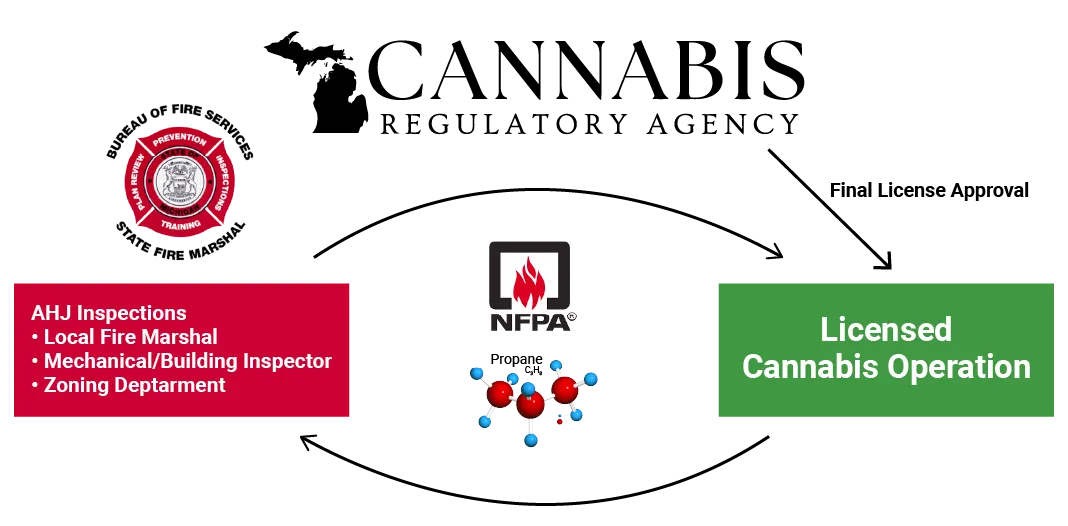
Authorities Having Jurisdiction (AHJs) are code officials who inspect and approve cannabis facility’s safety systems:
Local Fire Marshal – inspects propane tanks, fire code compliance (NFPA 1, 58), emergency shutoffs, ventilation
Mechanical/Building Inspector – propane appliances, piping permits, venting, combustion air (Michigan Mechanical Code)
Zoning Department – Tank setbacks, hazardous material limits, land use approvals
Cannabis Regulatory Agency (CRA) – Final license approval after local AHJs approve build and safety
CRA Inspection Checklists
- Compliance Best Practice Guide
- Expectations for Maintenance of Standard Operating Procedures
- Marijuana Plan Review Checklist
- Grower Field Inspection Checklist
- Processor Field Inspection Checklist
- Field Operations - 30 Day Post Licensure Checklist
- Field Operations - Prelicensure Checklist
- Field Operations - Semi-Annual Checklist
CRA Rules
BFS / Cannabis Facilities Code Spotlight - Propane
A state fire official including fire marshal inspects a facility using:
NFPA 1, 2018, “Fire Code” and
NFPA 58, “Liquified Petroleum Gas Code.”
Below are additional regulations regarding closed loop systems when using propane.
NFPA 1, 2018, “Fire Code” – order from MRA or NFPA here
R 420.202 Adoption by reference.
Rule 2. (1) The following codes, standards, or regulations of nationally recognized organizations
or associations are adopted by reference in these rules:
(a) National fire protection association (NFPA) standard 1, 2018 edition, entitled “Fire Code” is
adopted by reference as part of these rules. Copies of the adopted provisions are available for inspection and distribution from the National Fire Protection Association, 1 Batterymarch Park, P.O. Box 9101, Quincy, Massachusetts, 02169, telephone number 1-800-344-3555, for the price of $106.00.
(b) National fire protection association (NFPA) standard 58, 2020 edition, entitled “Liquified Petroleum Gas Code” is adopted by reference as part of these rules. Copies of the adopted provisions are available for inspection and distribution from the National Fire Protection Association, 1 Batterymarch Park, P.O. Box 9101, Quincy, Massachusetts, 02169, telephone number 1-800-344-3555, for the price of $70.50.
(2) The standards adopted in subrule (1) of this rule are available for inspection and distribution at the agency, located at 2407 North Grand River Avenue, Lansing, MI, 48906. Copies of these standards may be obtained from the agency at the cost indicated in subrule (1)(a) and (b) of this rule, plus shipping and handling.
NFPA 1, 2018, Chapter 38, Marijuana Growing, Processing or Extraction Facilities
NFPA 1, 38.6.2 Liquefied Petroleum Gas (LPG) Extraction
- Compliance with 38.6.1 and 38.6.2
- Exhaust Systems
- NFPA 91 Standard for Exhaust Systems for Air Conveying of Vapors, Gases, Mists, and Particulate Solids or mechanical code
- Electrical
- NFPA 70 NEC
- Lighting and equipment interlocked with exhaust system
- E-power: lighting, ventilation system, solvent gas detection
- NFPA 70 NEC
- Gas Detection < or + to 25% LEL/LFL
- Protection
- Automatic Suppression: NFPA 12, 13, 17 and 2001
- Piping
- NFPA 58 LP Gas Code
NFPA 1, 38.6.3 Flammable and Combustible Liquid Extraction
- Compliance with 38.6.1 & 38.6.3
- Exhaust Systems
- NFPA 45, NFPA 91 Standard for Exhaust Systems for Air Conveying of Vapors, Gases, Mists, and Particulate Solids or mechanical code
- Electrical
- NFPA 70 NEC
- Lighting & equipment interlocks with exhaust system
- Storage, Use & Handling
- NFPA 1 & Chapter 66 Flammable & Combustible Liquids (NFPA 30)
- Heating of flammable/combustible liquids over open flame is prohibited
NFPA 1, 38.6.7 Transfilling
- Addresses working container connected to extraction equipment
- Comply with:
- Section 69.3.5 Container Separation Distances [58, 6.4]
- Section 69.4.2 Operational Safety [58, 7.2]
- NFPA 58 LP-Gas Code
Liquid Petroleum Gas (Propane) Extraction: Source BFS
- LPG containers SHALL NOT be stored in extraction room
- Transfilling shall take place outside of extraction room
- Extraction Solvent must be identified e.g. LPG
- Shall have an automatic emergency power system installed
- Used plant material must be allowed to off gas in booth/hood
- Compressed Cylinders must be secured from tipping and not be stored in the extraction room area
- Flammable and Combustible Liquid shall be stored in an approved flammable liquid storage cabinet
- LPG extraction must be done in closed loop extraction machine system
- Extraction machine has to be in Classified 1, Division 1 (C1,D1) booth or lab hood
- Booth or hood shall have interlocking features
- Shall have gas monitoring set to 25%LEL/LFL
- Shall have automatic suppression system in booth / hood along with duct work
- Heating of flammable or combustible liquids over open flame is prohibited